

You might feel scared when you see a crack in a building or wall made of concrete.
But if there's a crack, does that mean the building's actually broken?
Not all the time.
As concrete gets bigger, it can crack, or it can shrink by itself, or when the temperature changes. Some of these may be caused by settlement, vibration, movement of the building, or work being done nearby.
It's annoying when you can't tell if a crack is getting bigger or staying the same.
For this reason, it might be smart to keep an eye out for slab cracks.
Monitoring allows you to watch a crack over a period of time, instead of just inspecting it once. They watch the crack change to tell them what is going on and if they need to do some more research.
Look at the crack in the concrete, see how it travels.
Say you see a small crack in the wall of a house.
On first observation, its size and location are noted. After a certain period of time, the same crack is examined again.
If nothing has changed, then the crack might not change.
What if it changes in another way, for example, longer or wider? You probably have to pay a little more attention to it.
So, instead of just asking:
“Is there a crack?”
It helps us answer the more important question:
“Is the crack changing?”
Concrete is strong and durable, but there are many things that can break down concrete.
It's often because of these things:
As it dries and cures, the concrete will shrink. Thus, there may be little cracks here and there.
The concrete expands and contracts with temperature. Maybe something to consider in the UAE, where houses are often left open to the heat.
If the ground moves, it can put stress on a building and cause cracks to appear.
Heavy equipment work such as digging, piling, tearing, tunneling, etc. can cause the ground to move or shake. This can affect nearby buildings.
A change in use of a part of a building or additional weight may put a greater strain on a building.
You should know how cracks work before you decide what to do because many things can cause them.
A crack that doesn't seem very big now might look different in a few months.
That's why a crack picture or measurement alone might not show everything.
You can watch and see how the crack has changed over time.
As an example:
Tracking data can help engineers figure out how the structure is working, but it can't always explain why a crack shows up.
There are many business, home, and factory buildings in the UAE. Along with that are roads, tunnels, bridges, and government buildings.
A lot of places are putting up new buildings next to old ones.
People may be afraid that nearby buildings will move when heavy work, digging, piling, or tearing down buildings is going on.
Concrete crack tracking in the UAE allows you to know the extent of the cracks before work begins, and you can monitor them during construction of the building.
Experts, workers, and project leaders can see what's going on with this.
It's not really hard.
They are the ones who check out the building first when they get to the site.
Cracks that are already there are found, and areas that could be dangerous are marked.
Important things are put down, like
This is where the first set of data starts.
You can then compare measurements made in the future to this point.
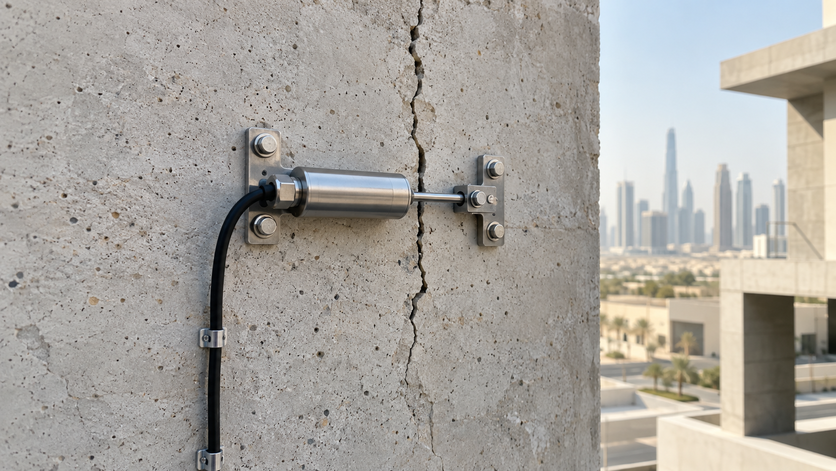
Crack-tracking tools, gauges, monitors, and other ways to check the size of something can be used for different tasks.
It has been agreed upon how often to look for cracks.
Projects need to be checked every once in a while. But projects that need to be watched more closely might need to collect data more often or all the time.
People compare their thoughts about the present to their thoughts about the past.
This will either make the crack move or stay the same.
Reports of measurements, pictures, observations, and changes that were made can be used to show the results.
After that, engineers and project teams can look into this information further.
The type of building and how it needs to be watched determine the technology that is used.
People often do things in these ways:
These can be put over cracks to watch how much they get bigger over time.
When you use digital tools, it may be easier to keep track of and compare information.
You can see how the crack changes over time by taking pictures of it at different times.
Tracking movement over time with sensors is possible for long-term projects.
Surveying and measuring tools that are more advanced in 3D can help find places in bigger structures where they are moving or changing shape.
Get the right information that helps experts figure out what's going on. That's the clear goal.
In many cases, it is helpful to keep an eye out for cracks in concrete.
You can do so for:
Building sites close to houses that are already there
It helps a lot when work is going to be done close to a building that already has cracks.
Having a professional check for cracks in concrete can be helpful in a few ways.
“If you check regularly, you can find cracks before they even show up.
Engineers can learn useful things from measurements, not just look at stuff.
You look at a crack that is open and see if it changes or not.
Being aware of work going on nearby, like digging, piling, tearing down, or other types of work, can help you find cracks that are already there.
Monitoring can give people information that can help them decide if they need to do more work, study, or repairs.
A tracking tool keeps a useful record of how the building is doing over time.
Not at all.
Do not forget this very important thing.
A house with a crack is not dangerous.
It's important to know what caused the crack, where it is, and how it works.
A small crack on the surface that is caused by regular shrinkage might act very differently from a crack inside the material that is moving.
So, pay attention to the change and try to figure it out before you get scared.
Service that checks for cracks in concrete might be something you want to look into if:
You want a good, long-lasting crack.
Crack tracking is more than just taking pictures every once in a while.
Measurements need to be taken regularly and correctly recorded for the results to be useful.
An expert tracking team can help with the following:
Crack monitoring can be combined with other structural monitoring and inspection methods on bigger projects to get a better picture of the structure's overall condition.
The important thing to know about a crack is whether it changes over time.
Crack monitoring is a handy way for engineers to stay on top of these changes and to learn more about how a building is doing and how it is moving.
If you are managing a building, bridge, tunnel, infrastructure project, or construction site in the UAE, tracking can help you identify what needs to be inspected and repaired.
Have you noticed cracks in your structure? Want to build adjacent to an existing building? Falcon 3D is your partner for professional concrete crack monitoring and structural solutions tailored to your project needs.
Contact Falcon 3D to discuss your concrete crack tracking needs.